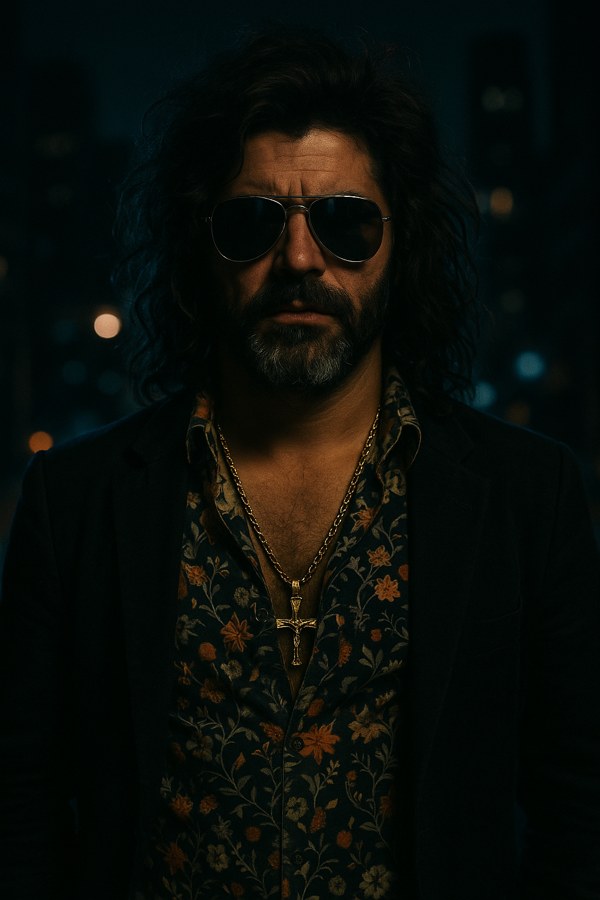
The atmosphere is dense: a cigarette burns, and an electric guitar reverberates in the distance. Paul sits at the microphone, his voice raw and abrasive, as though he has just finished shouting at a concert or whispering secrets in a dark alley.
Paul, welcome. It is a pleasure to have you here to talk about the Volcren universe. Let’s start at the beginning: what exactly is this project?
(His voice is deep and raspy.) Thanks for inviting me. Volcren isn’t your usual band in the garage down the street. It is an experiment, a solitary journey born of sleepless nights, real guitars and dreams that perhaps shouldn’t be real. It is where raw poetry and alternative rock meet artificial intelligence. I am the face and voice of this chaos, but behind it is one mind, Paolo Righini, using technology like a paintbrush covered in mud.
You already have quite a substantial discography. Can you take us through it?
(He sighs, his voice growing hoarser.) Everything began with Shadows & Reveries. We were exploring the space between the darkness we hide and what keeps us alive. It is a record of shadows, moving from the anger of Lies to the melancholy of childhood memories. Then Different Ways marked an evolutionary leap. Things became serious: Paolo began bringing in his real electric guitars, creating original melodies that Suno AI then turns into complete arrangements. It has two hemispheres: Love & Death and Chains & Empires.
Then came Piatti Forti, a record full of sweat and imagination, where Italian tradition and digital experimentation meet in songs such as Sai che vita and the nocturnal ballad Luna. And don’t forget Asphalt Jungle: a map of inner landscapes, where asphalt is more than a road; it is the hard, reflective substance of the modern world.
You have mentioned Suno AI several times. What is your relationship with this ‘machine’?
Look, many people think Suno is a ‘magic button’. For us it is a virtual band that needs firm direction. It is a real-time dialogue between human impulse and artificial architecture. Paolo writes the lyrics, records guitar riffs as ‘seeds’, then guides the AI with detailed prompts, deciding how much room to leave for the code’s ‘madness’ and how closely to hold to our signature sound. The machine builds the sound, but the soul remains stubbornly human. We aren’t looking for perfection. We are looking for truth.
Archemondo comes up often in your universe. What does it mean to you?
(He clears his throat; his tone becomes almost mystical.) Archemondo is our geography of the depths. It is where female figures become archetypes, mirrors and inner presences. Where desire blurs into fire, and death is not the end of energy but a transformation, as we sing in Papo’s Restaurant. It is a universe of external landscapes that project our states of mind: cities like asphalt jungles, and seas that know our names.
One last question, Paul. What philosophy holds all this together?
(A bitter smile.) ‘There are no right roads, only different ways.’ We accept our fragility, our scars and even our mistakes, because every mistake becomes part of the melody. We are here to confess, not to perform a role. Our music invites you to recognise a piece of yourself in the chaos. Because in the end, even a soldier has to lay down the uniform and accept peace after the struggle. That is all: shedding our roles and looking at life with tenderness.
Paul stands. His footsteps recede as a dirty guitar riff rises in the background.
English translation of the official Volcren interview.
Read the original interviews in Italian (PDF) ↗